
 ” width=”333″ height=”316″>
Slot RTP & Volatility: Your Secret Weapon in Online Gambling
- Rosie Bond
- 12 Jul 2023
Do you want to win real money playing online slots? If the answer is a resounding YES, you ought to know about RTP and volatility. In this article, we’ll explain what they are, how they work, and how they can be exploited to maximize your chances of winning.
Understanding RTP and Volatility: What Are They?
Slots are a game of chance. But even with games of chance, there are certain approaches that can increase your chances of winning.
With most games, this can be done by understanding the rules: when you understand the rules, you can calculate, or infer, the best possible action.
With slot games, this can be done by understanding the slot’s mechanics. Namely, the RTP and the volatility.
Let’s go over what these mechanics are and how they function:
Casino games have odds that determine the likelihood you will make a profit. With slot games, the “odds” are calculated by measuring its return to player, or RTP.
RTP is self-descriptive: it measures how much of total stake, on average, a slot returns to players of the slot. In theory, that’s all it is. In reality, it’s a little more sophisticated.
RTP is a measurement taken over an almost infinite number of spins, and therefore isn’t an accurate reflection of any single player’s game.
So, let’s go over what RTP can show us, and what it can’t show us:
- Imagine you have $100 and you choose to play a slot game with an RTP of 96%. If you were to spend this entire $100, it doesn’t mean the slot will return $96. The RTP of a slot game isn’t an accurate measure of small wagers.
- Now imagine you win the lottery, and you’re going to wager $1,000,000 on the same slot game. Even though you can still win or lose money, the more you wager, the more your return will start to resemble the RTP of the slot.
The trajectories of your game, therefore, will depend a lot on your budget and how much you ultimately wager. At any point in time you could win more or lose more than the RTP.
Let’s use a chart to illustrate how it works. Say, for instance, that you have 10 sessions on a slot with an RTP of 97.8% and, for the sake of our argument, you make something like 1,000,000 bets (so that the RTP is accurately reflected).
While none of you individual sessions match the RTP, your winnings will average out at the RTP:
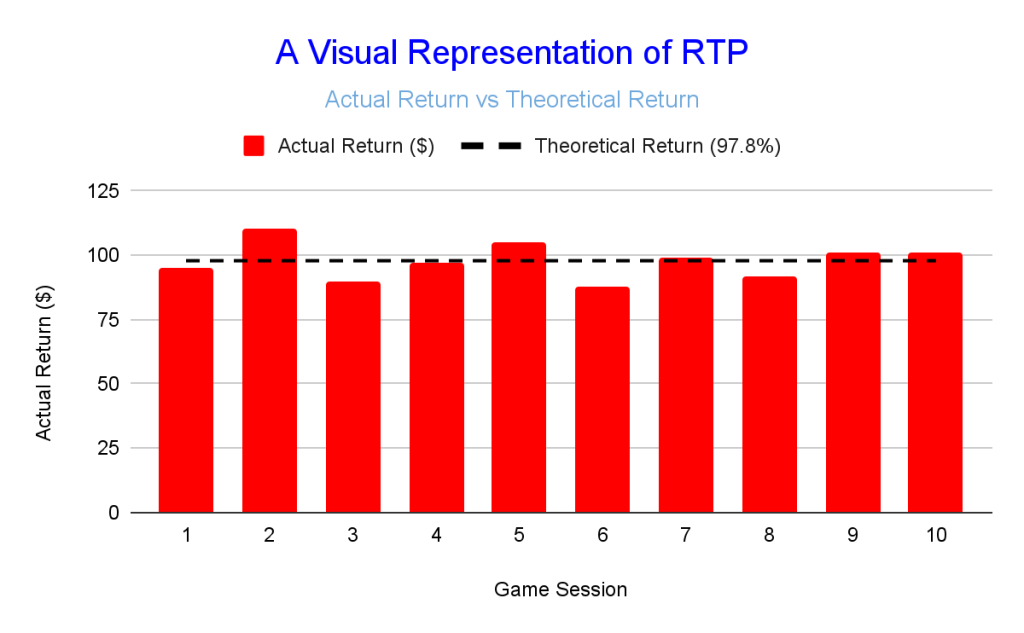

Let’s study the chart for a minute!
Do you see bar 2 that ascends above the slot’s RTP? That’s what you want to happen. This bar likely represents a shorter session, as the longer you play slots, the less likely you’ll win.
Think of playing a slot like carrying out a bank heist: the quicker you get in, make a profit, and get out, the better.
Volatility is a way of measuring the risk associated with playing a slot. A high volatility carries a high risk that you will lose your bet; a low volatility slot carries a low risk. But this doesn’t mean that low volatility slots are generally better.
For example, a high volatility slot may be erratic and carry a high risk, but with high risk comes high rewards. You may go a long time without spinning a winning combination, but when you do, the payouts can be huge!
Low volatility slots, on the other hand, have a more consistent payout structure: the wins are more frequent, but they are far smaller.
Another way to think about it is that the volatility of a slot describes the short-term patterns of the slot game.
Let’s use a graph to illustrate how volatility maps onto RTP:
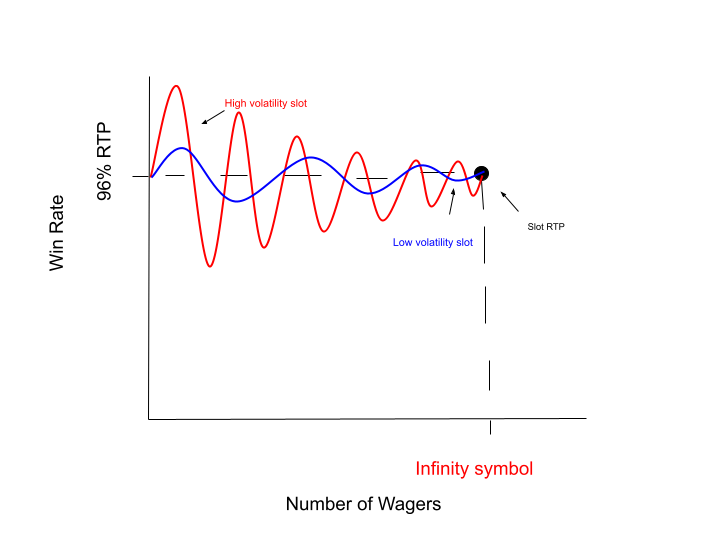
Here’s what the graph tells us:
- High volatility slots have steep gradients, which basically mean that at any point you can win a lot, or lose a lot. Wins are infrequent, but when they occur, they’re rather large.
- Low volatility slots minimize losses, but at the same time, playing them will reduce your chances of winning large amounts.
- Conclusion: Regardless of the volatility, the RTP will have an inexorable grip on your game session. Over time, all game sessions will start to resemble the RTP of the slot game.
Key Takeaways
Do you want a quick summary of RTP and volatility?
Here are the key takeaways from our discussion:
- RTP measures the average return to players of the slot. Or, in other words, how much the slot will return over an infinite number of spins. It does not guarantee a win or a loss, but provides a general insight into the odds of a slot.
- Volatility measures the associated risk of a slot game. High volatility slots provide infrequent wins of a high value, low volatility slots provide frequent wins of a low value.
- Regardless of a slot’s volatility, the RTP will eventually begin to exert influence on a player’s gaming session. The fewer bets you make, the greater the variance of your return.
Slot RTP and Volatility Strategies: Top Methods for Smarter Betting
Let’s consider for a moment how to leverage RTP and volatility to improve our chances of winning on a slot game.
It’s clear that a high RTP is a clear indication of superior odds. But what about volatility?
The truth is that the optimal RTP and volatility depends on a number of factors, such as your budget, whether or not you’re using a bonus, and other slot mechanics (such as the tendency for a slot’s RTP to increase when you maximize the bet value).
In all cases, we recommend you take a holistic approach and consider all factors.
For example, imagine that you intend to claim a no deposit bonus. In this case, we recommend you claim a no deposit bonus valid on a slot game with a high RTP and a low volatility.
Here’s why:
- To win real money with no deposit bonuses, you have to satisfy the wagering requirements, which are a multiple of the bonus value.
- For instance, if you claimed a $10 no deposit bonus with wagering requirements of 10x, you’d have to stake $100 before you could withdraw.
- Consequently, it is vital that you manage to maintain a positive bonus balance over the short term.
- By playing a slot with a low volatility, you are more likely to maintain a positive bonus balance in the short term as you are more likely to spin frequent, albeit small, winning combinations.
- Over the long term, the high RTP will provide you with the best chance of producing an overall profit.
Expert Tips & Tricks: RTP & Volatility
High Volatility Games
The key here is patience. Anyone that plays a high volatility game has to be able to endure long dry-spells. Wait them out. Don’t chase losses. And you will, eventually, be rewarded with a large win.
Low Volatility Games
Search for slot games with additional bonus features, such as multiplier rounds and free spins rounds. Wins in the base-game will be small and frequent; bonus rounds are often lucrative.
High RTP Games
Your chances with high RTP games are generally great. They allow for flexible decision making: if you are currently losing money under the RTP, keep playing; if you are making a profit, be wary of extending your session.
Low RTP Games
Your chances of winning are generally poor with low RTP games. Short gaming sessions are optimal. The more time you let your session elapse, the less likely you will make a profit.
What is a good RTP for a slot game?
It depends on a few factors, but generally we like to recommend slot games with an RTP of 96% or more. This gives you a decent chance of winning. However, with certain slot types – such as progressive jackpot slots – the RTP is artificially inflated by the enormous and unlikely jackpot, so consider this before you play.
Conclusion
Slot RTP and volatility can have a huge impact on your chances of winning. Of course, the impact differs depending on the context. The information contained in this article should help you leverage your knowledge of the slot’s mechanics to increase your chances of winning.